



Troubling developments unfolded in the U.S. bond market on Thursday that had some investors drawing comparisons with the run-up to the 2008 financial crisis.
The current problems start with rising oil prices as a result of the U.S.-Israeli war against Iran, which is raising the risk of stagflation and the prospect of a 2026 interest-rate hike by the Federal Reserve. Brent crude the global oil benchmark, briefly blew past $119 a barrel on Thursday as attacks escalated on oil-and-gas infrastructure in the Persian Gulf. West Texas Intermediate crude-oil futures briefly crossed $100 a barrel.
But even as oil prices have spiked and stock prices come down, Treasurys, often seen as a haven during times of market unease, haven’t rallied on a continual basis. Instead, fears that the war in the Middle East could morph into a full-blown energy crisis pushed the policy-sensitive 2-year Treasury yield above the Federal Reserve’s interest-rate target on Thursday. Bond yields move inversely with prices and rise during selloffs.
Thursday’s bond-market selloff caused the Treasury yield curve to exhibit what traders describe as a “bear-flattening” pattern. This actually began back in early February. Typically, the pattern emerges when bond traders are bracing for a difficult economic environment ahead.

The confluence of these three developments — oil above $100 a barrel, a 2-year yield above the fed funds rate, and a bear-steepening dynamic in the bond market — is making some investors nervous.
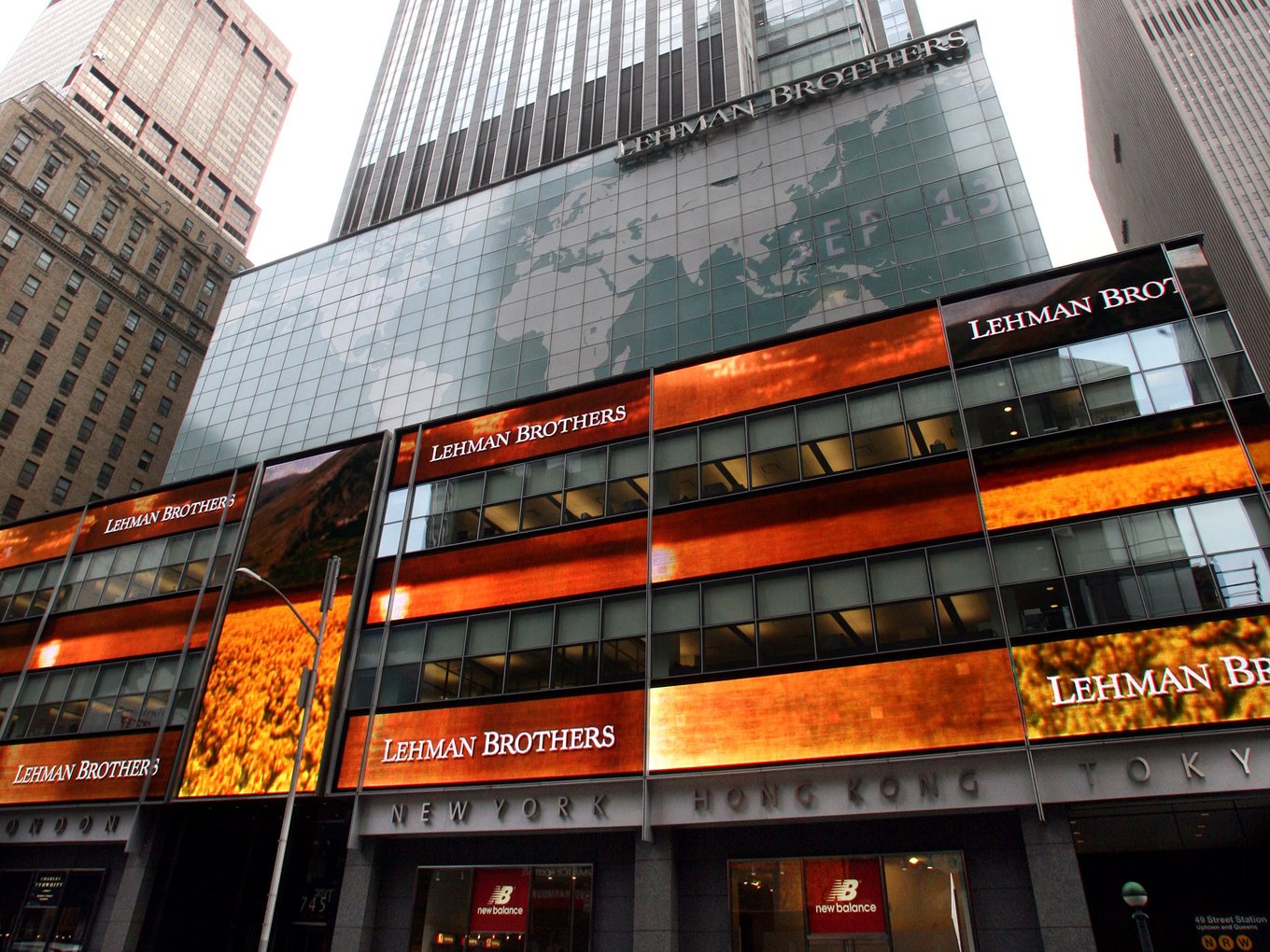
The last time all three things unfolded simultaneously was in the late spring of 2008, according to Bloomberg data. About four or five months later, Lehman Brothers collapsed, ushering in the most acute phase of the 2008 financial crisis. The S&P 500 declined 38.5% that year. Widespread mortgage defaults also resulted in many Americans losing their homes.
The current environment includes both similarities and differences to that troubling time. Whereas the 2008 crisis was triggered by the bursting of a housing bubble and the subsequent collapse of the subprime mortgage market, investors are currently focused on the continued war with Iran, which began on Feb. 28, as well as signs of increasing stress in the private-credit industry.
Already, investors have been impacted by twin declines in stocks and bonds, which amount to a double-whammy for anybody holding their retirement savings in a 60-40 portfolio.
The backdrop now “does remind me of 2007-2008, when you did have cracks in the financial system,” said economist Derek Tang of Monetary Policy Analytics in Washington. The bad news now is “we are going into an energy-price shock and the Fed’s hands are tied because of inflation risks, which make it harder to cut rates.” This is all happening as the chance of a U.S. recession is growing, which is “not healthy” for risk assets. “That’s why people are on a knife’s edge right now.”
All three major U.S. stock indexes closed lower on Thursday, despite attempting to climb during the final hour of trading.
Earlier in the day, the 2-year yield, which is tied to expectations for the path of interest rates, jumped by as much as 21.8 basis points to an intraday high of almost 3.96% as the underlying government note aggressively sold off. The rate rose 8.8 basis points to 3.83% by 3 p.m. Eastern time, leaving it above the Fed’s interest-rate target of between 3.5% and 3.75%
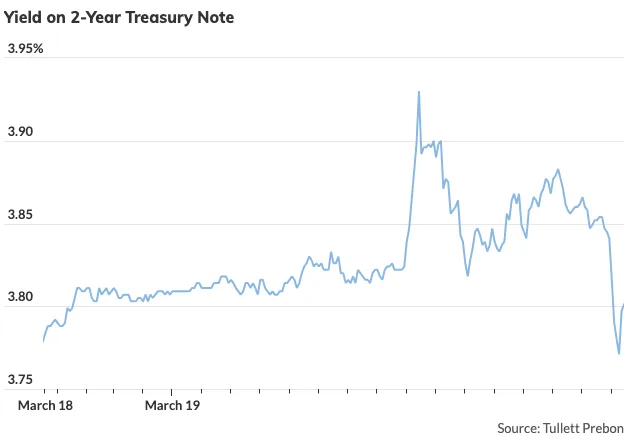
The 2-year yield climbed at a faster pace than the benchmark 10-year yield which rose just 2.5 basis points to 4.28% —producing a bear-flattening pattern of the Treasury curve. The difference between 2- and 10-year Treasury yields shrank to around 45.1 basis points on Thursday from 51.5 basis points a day ago, and it is down from 74 basis points in early February.
The curve’s bear flattening is already hurting financial institutions, which rely on borrowing at short-term rates to lend at long-term rates, and retirement-age investors who held the 2-year Treasury note because of its cash-like qualities. As the note sells off, its yield rises so those older investors could have waited to buy at a lower price and higher yield. The bear-flattening’s significance to investors more broadly rests in the signals it sends about the likely upward path for interest rates and a negative economic outlook.
The 2-year rate is pricing in a scenario in which “the Fed will have to move into a rate-hiking cycle for the next few years,” said Ben Emons, founder of the New York-based investment management firm FedWatch Advisors, who added that he does not share this view.
However, a repeat of the 2008 financial crisis is not necessarily in the cards because “we’re not in stagflation yet and the economy is not as reliant on oil prices as it was back then,” Emons said in a phone interview. “We have private-credit issues, but there’s a difference between that and the subprime crisis at the time. The banking system is far more resilient than before.”
Fed-funds futures traders currently see a 93.8% chance of no change in borrowing costs this year and a 6.2% likelihood of one rate hike by December. On Wednesday, Fed Chair Jerome Powell lent some credence to the idea of a hike by saying officials have deliberated on whether their next move should be to lift rates, though this is not currently the central bank’s base-case scenario.
