


Wrapped up in layers of fleece, with glasses perched on the end of his nose and a Breton-style cap on his head, the professor reads out a question sent by a stranger from the other side of the world. Behind him, floor-to-ceiling bookshelves are stacked with well-used works of classical thought, from Adam Smith and Max Weber to Montesquieu and de Tocqueville.
“My parents and relatives all expect me to get into a good university,” Alan Macfarlane reads. “I don’t know how to face their expectations and everything they have given me. What should I do?” The 84-year-old British anthropologist lifts his head, pushes his rimless frames up his nose with both hands and begins his answer. “This is presumably quite a widespread anxiety and worry for young people in China.”
An almost-identical scene happens every few days on Xiaohongshu, a Chinese social media platform popular with young people. Like Instagram or TikTok, it’s full of videos that seek to grab attention within seconds. So when the Cambridge academic started posting advice in 2025 to young Chinese thousands of miles away, he didn’t expect much traction. “I would say that it was impossible,” says Macfarlane, who often layers up in a cap and fleece, though he does sometimes sport a light woolen blazer. “An elderly, white, male, upper-middle-class, Western person could not be of interest to young, Chinese, female, Eastern people.”
But in just 17 months, his account attracted more than 2.5 million followers. Chinese viewers, drawn in by his rumpled academic style and messages delivered at a languid, deliberate pace, dubbed him Dumbledore, the headmaster of the wizarding school Hogwarts in the Harry Potter series. In April, Macfarlane posted a video with the title: “I’m very curious: Why would you follow my account?”
“Because you are a cute little old man,” came one reply. Another was more serious: “Because we are very lost; the younger generation is extremely lost amidst various macro factors.”

The Dilemmas of Life
Now an emeritus professor of anthropology, Macfarlane spent his working life studying humanity and attempting to understand how and why societies evolve the way they do. After decades working in England, as well as Nepal, China and Japan, he embraced social video as an effective way to communicate what he has learned.
Macfarlane has posted on YouTube for years, building up a collection of lo-res, straight–to-camera videos as well as interviews and other clips. When he joined Xiaohongshu, his 5- to 10-minute posts mostly introduced his books, which cover subjects from the history of tea to British individualism. He usually records at a desk in his “time and space machine,” a converted hay barn outside Cambridge, surrounded by books and his wife’s jigsaw puzzles of the work of Dutch masters mounted on the ceiling above him.
Over time, Macfarlane opened up to viewer questions, prompting queries about academic subjects, such as how to understand religions, or what, actually, is anthropology? But gradually the questions began to focus on life’s dilemmas. Should I pursue a liberal arts degree when my parents urged me to learn something more practical? How should one pass through the confusions in the early 20s? Or even, is an ordinary life worth living?
These questions offer a glimpse into the widespread anxiety among young people in China. They are navigating a sluggish economy — urban youth unemployment rose to 19% in August — and face uncertain job prospects as AI threatens to take away many entry-level roles. Some workers, especially those in state-backed institutions and the finance industry, have endured pay cuts. Others describe the intense competition that forces them to work harder without more reward, an exhausting treadmill known as neijuan, or rolling inwards.
Nostalgia abounds for the 2000-10 boom years, when China’s gross domestic product grew by 10% each year, on average. This year it is forecast to slip below 5%. On Xiaohongshu, many talk about “beauty in the time of economic upswings,” often associated with pictures of colorful outfits and daring TV commercials from the 2000s. In China, but also in the US and UK, “the assurance of a job and a ladder of promotion and so on has more or less disappeared,” Macfarlane says.

A typical “social therapy,” as he calls it, consists of three parts. First, acknowledging there is a problem and that it’s shared by millions of others in the world. Then, instilling hope, telling the questioner not to give up. And finally, some practical tips. For example, if your parents want you to get into the best universities but you don’t think that’s likely, have a discussion with them. Be explicit, Macfarlane says, suggesting a formula: “There’s only a certain number of people who are going to get to the top,” he says. “I probably won’t, and this doesn’t mean that I don’t love you and I haven’t tried my best.”
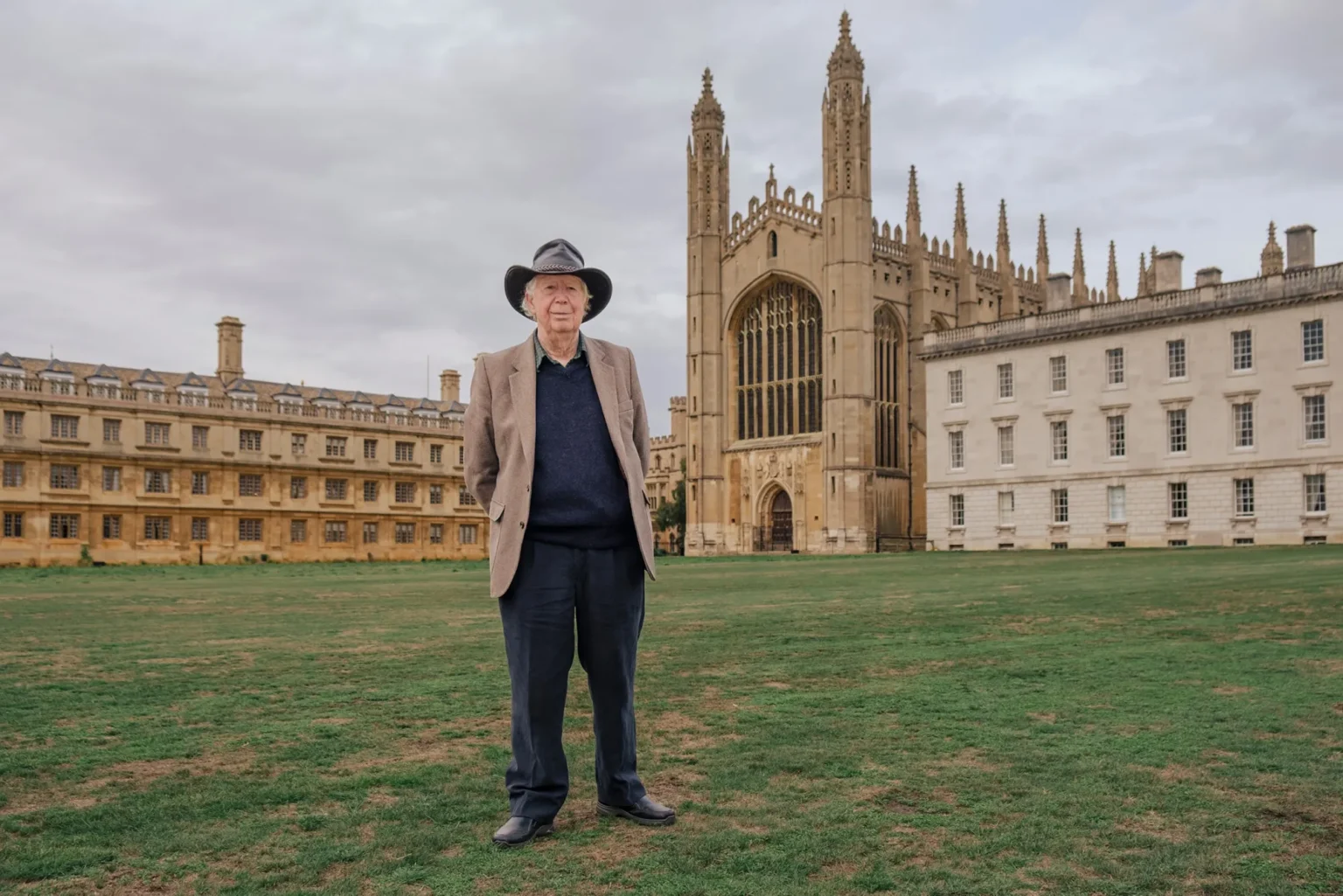
That advice may sound simple, but it has resulted in a following unmatched by many other scholars on the platform. When we meet, in an 18th century room at King’s College, Macfarlane credits his calm, middle-class English accent and Cambridge credentials for at least some of his popularity. “Also, acknowledging that this is a problem and that many people have this problem,” he adds.
His calmness resonates with 27-year-old Shanghai resident Ashley Zhang, who describes Macfarlane as “a role model worth emulating.” She followed his example by offering her younger brother support when he was considering quitting his job. “I’m learning to be like him,” she says of the professor, “someone who listens attentively to friends and family with patience, offering answers without any air of lecturing.”
Making of Dumbledore
It’s rare for a foreigner to build a big following on Xiaohongshu, also known as Rednote outside of China. The app is still primarily used by Chinese speakers, despite a brief popularity surge among US users in early 2025 ahead of TikTok’s brief local shutdown. It has more than 350 million monthly active users, with more than 80% of them aged between 18 and 34, according to data provider Qiangua. Three-quarters of the users are female.
Macfarlane can’t take all the credit for his success. He doesn’t run the account alone, with questions mostly curated by Chinese colleagues. Qin Yuchen, who first met Macfarlane as a Master’s student at Cambridge in 2015, manages his accounts day to day, on Xiaohongshu and now other video platforms like Douyin, TikTok’s Chinese sister app.

Qin, who also translates Macfarlane’s books, says the Xiaohongshu effort was initially a bid to promote Chinese editions of his works. She knew Macfarlane wouldn’t be a conventional social media influencer, but she saw potential. “He has a rare ability to discuss large and sometimes difficult questions in a warm, personal and accessible way,” Qin said by email.
While suggesting that they’re open to the idea of monetizing Macfarlane’s content, Qin says there isn’t a specific “model” in place yet, and generating profits isn’t a primary goal. “The most natural connection is with his books,” she says. In August, Macfarlane published a book compiling his thinking on 260 topics, ranging from cricket to corruption and even the “difficulty of understanding China.” (A video version is on his personal YouTube channel.) These essays will soon be reorganized into a series of books in Chinese.
Interest in Macfarlane’s personal life has also risen. In April, a picture of him chatting with two other people while holding packs of chips on the King’s College lawn went viral on Xiaohongshu, with more than 15,000 likes. Videos of his rooms and archives, filled with papers and photos collected over decades, are also popular.
The success has left him too busy to write personal replies to anyone who emails him a question, though he stays in touch with established friends, like Li Shuo, whom he met in 2012 when she was a sophomore at Zhejiang University. Li recalls Macfarlane encouraging her to pursue her dreams and be herself.
“Without Alan, my personality would likely be completely different,” she says. “He essentially steered me in a whole new direction. As a result, I’m able to live with a sense of independence and self-confidence.”
Li says Macfarlane is now sharing with millions of other young people in China the insights and wisdom he once shared privately with her. Many of those who find him online today feel equally lost. “I think this is a very laudable act,” she says.
