


“Communism was never popular in China,” Frank Dikötter argues in his new book, “no more so than in Finland or in the United States.” It was “brought to the population at the barrel of a gun”. Behind that barrel was the hand of the Soviet Union, without which victory would have been impossible. After the second world war, Soviet intervention transformed China’s Communist Party from a battered, marginalised guerrilla force into a heavily armed military machine.
Read histories approved by the party and a different picture inevitably emerges. In those tellings, when the party was founded in 1921, it harnessed widespread public discontent with the country’s chaotic rule by competing warlords and the occupation of its territory by foreign powers. It survived attempts to crush it by the Nationalists, who gained nominal control in the late 1920s, and staged a heroic “Long March” in the mid-1930s to set up a base in Yan’an. It played a crucial role in defeating the Japanese in 1945 and overthrew the corrupt and brutal Nationalists four years later at the end of a civil war.
Mr Dikötter, a Dutch-born historian of modern China, laments that in scholarly volumes and popular books, the party’s version of events is reflected all too often. He may overstate the degree to which accounts of the party’s rise favour its “fairy-tale” view. Works such as Jung Chang’s “Wild Swans” (1991) and her subsequent “Mao, the Unknown Story” (2005), co-authored with Jon Halliday, offer devastating critiques of the party’s ruthlessness and deceptiveness before it seized power. So do more academic books, such as “Mao: The Real Story” (2012) by two American-based scholars, Alexander Pantsov and Steven Levine, who, like Mr Dikötter, draw extensively from Soviet archives.
But Mr Dikötter’s account is not a family history like “Wild Swans”, nor a biography. It is a systematic dissection of the party in its formative years. It argues that far from a “triumph of great social forces unleashed and harnessed by the Communists”, the party’s victory in 1949 was the result of a “very traditional pursuit of power” and “the amoral application of military strategy”. Communist forces survived on “loot and ransom”, recruited bandits, traded opium and, in the civil war, used many unarmed civilians as human shields.
For evidence of this, Mr Dikötter trawled through well over 300 volumes produced in the 1980s by party archivists. They contain documents from the pre-1949 period and are intended for “internal” use only, meaning they cannot be read by ordinary members of the public. The volumes, however, have found their way abroad, where Mr Dikötter says that historians have made only “sporadic” use of them. One reason for this, he speculates, is that they show how peripheral the party was in China’s history until the end of the second world war, when the Soviets began tipping the scales. Before 1940 the percentage of party members among China’s population was comparable to the scale of Communist membership in America, says Mr Dikötter, and may have been inflated.
With a little help from their friends
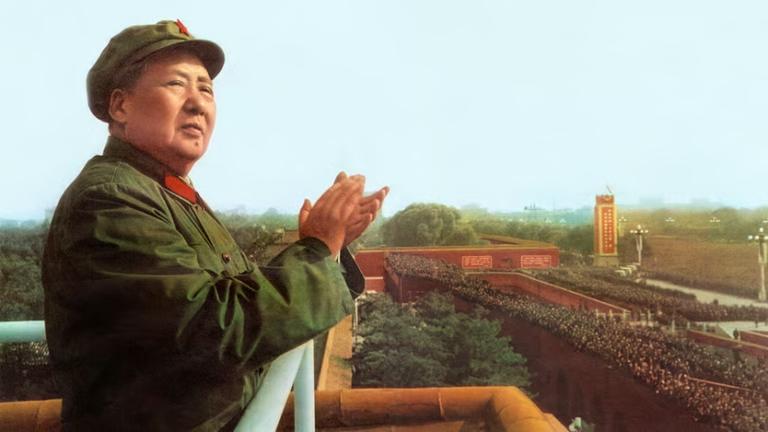
Before the end of the war, Soviet support for Chinese Communists often appeared half-hearted. Soviet leaders saw the ruling Nationalist Party, or Kuomintang (KMT), as vital to their efforts to keep Japan at bay. They urged both sides to co-operate in resisting Japan’s invasion of China. Mr Dikötter says Mao Zedong (pictured) preferred to keep his forces out of harm’s way so they would be able to fight the KMT.
Soviet calculations changed when Japan’s defeat appeared imminent in 1945. As Japan’s occupation of Manchuria, in China’s north-east, crumbled, Stalin sent nearly 1m troops into the industrial region. They seized control of major cities and ports and set about stripping the region of valuable industrial assets. Soviet troops denied the KMT access to Manchuria and China’s leader, Chiang Kai-shek, “was in no position to quarrel with Stalin”, says Mr Dikötter. When the Soviets withdrew in 1946 they allowed Mao’s guerrillas, who had infiltrated Manchuria, to fill the vacuum and take control of vast quantities of abandoned Japanese weapons.
Even at this point, the party’s defeat of the KMT was by no means assured. The Americans, however, gave the Communists another leg-up. General George Marshall, sent by President Harry Truman to mediate in the China conflict, believed the Communists were “merely rural reformers who could help shape a democratic China”, Mr Dikötter argues. Marshall pressed Chiang to hold back his army and arrange a truce. The resulting four-month ceasefire gave the Communists crucial time to build up their army with Soviet help. The military balance shifted completely.
If there is a weakness in this account of the party’s rise, it is that it leans heavily on official sources. The party’s archives provide valuable evidence of the atrocities its members committed—for example, in the early 1930s, when they admit that interrogations of suspected opponents of Mao “relied wholly on torture”. But such snippets are not a complete picture, and it was extremely hard in those chaotic and dangerous times for foreign journalists to investigate. Mr Dikötter does much to demystify events based on the sources available. But much fog remains.
