


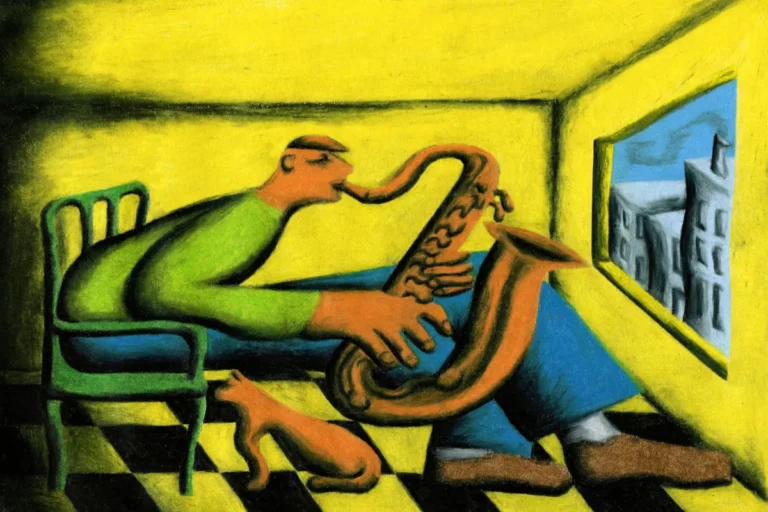
Listen closely and you’ll hear a famously sexy woodwind that’s been long forgotten, finally making noise again. The saxophone enjoyed center stage in American music before a drought in popularity starting in the 1990s. But recent signs suggest that the instrument has shed its cheeseball stigma and regained a place in pop culture.
Popular recent sax-forward acts have grown large audiences on social media from sharing recordings of gigs and impromptu public performances. Even regular consumers are finding their way back to the sax as a hobby that lets them unplug from life online.
Masego is a prominent new-generation saxophonist whose most popular track, Tadow, has been listened to more than 666 million times on Spotify. The Jamaican-born performer plays alto and tenor sax, adding improvisation to his own vocal recordings and live performances. He credits the resurgence to listeners regaining an appreciation for live musicianship, along with trends in sax-friendly musical genres, like the rise of African music.
“When you’re seeing the saxophone utilized on those types of rhythms, and then you saw Afrobeat’s rise in popularity and more of a larger respect for West Africa, to me the saxophone kind of fits right within that,” he says.
Years of obscurity
Saxophones weren’t always a punchline. Charlie Parker and John Coltrane ruled jazz playing them in the mid-20th century. Artists as varied as Aretha Franklin, David Bowie, George Clinton and Bruce Springsteen became legends by incorporating them into their sound.
By 1992, the sax still reigned in pop: Whitney Houston’s recording of I Will Always Love You, which featured Kirk Whalum’s memorable sax solo, kept hold of the No. 1 spot on the Billboard Hot 100 for 14 weeks. It made its debut in the US the same November day voters elected Bill Clinton president — which came months after millions watched him play tenor sax on Arsenio Hall’s late-night talk show.
But sax solos started disappearing from top-40 songs in the early 1990s, according to a 2023 report analyzing 1,081 songs with the solos released between 1955 and 2020. In the late ’50s, sax solos might appear on more than 60 top-40 songs in a single year. By the first decade of the 21st century, a whole year might go by without one.
Some in the music world point to how the sunglasses-wearing sax soloist had become a musical and fashion cliché, and fans started to note the sound’s lack of edge compared with what they were hearing from grunge bands in the early ’90s.
“Maybe legacy rockers like Meat Loaf still used saxophone, or legacy bands still touring, like Earth, Wind & Fire or Chicago,” says Jeremiah True, an executive with Taiwan-based saxophone manufacturer P. Mauriat. “But it wasn’t what the kids were listening to.”
Since the 2010s, however, a wave of new saxophonists has brought new styles and approaches, blending with genres like hip-hop, Afrobeat and electronic music, including notable works like Kendrick Lamar’s 2015 album To Pimp a Butterfly, which featured Los-Angeles-based saxophonists Kamasi Washington and Terrace Martin.
More recently, Whalum’s nephew, Kenneth Whalum, has worked with Beyoncé and Jay-Z. Grammy-nominated players like Chilean tenor saxophonist Melissa Aldana and New York City native Lakecia Benjamin have gained acclaim for new explorations of merging classic jazz with their own approaches to improvisation. And jazz saxophonist/conductor Immanuel Wilkins received a “genius grant” from the MacArthur Foundation in September.
Now in his mid-30s, Masego began playing in middle school, inspired by everyone from jazz great Sonny Rollins to hip-hop producer DJ Jazzy Jeff.
He recalls the saxophone being mocked around the time he was learning to play, which he blames on the exaggerated ways players often dressed and performed. He remembers the stereotype of the shirtless sax guy — a look mercilessly skewered in a 2010 Saturday Night Live sketch with Jon Hamm. Musicians like Kenny G and songs like “Maneater” by Hall and Oates became perceived in many corners as the opposite of hip.
“The saxophone started being associated with corny, quirky, zany things,” Masego says. “I was trying to make sure I kept it perceived as cool, because cool was my religion.”
A theme becomes a meme
Some of the renewed interest in the sax is rooted in irony. It’s become hard to miss the tragicomic “saxophones getting louder” meme that started surfacing this spring on social media.
It stems from a wailing instrumental piece composed by Stanley Clarke for the 1991 movie Boyz n the Hood. Whalum played the piece, his crescendoing tenor sax amplifying the pain of a scene where a central character gets killed in a drive-by shooting.
The online videos show far less serious bits of misfortune. Sometimes a person arrives home to discover they’ve been accidentally locked out by a pet. The WNBA’s Atlanta Dream has played the solo over loudspeakers after clinching home-court wins to signal to opponents that their time has run out.
Whalum, now 68, says he finds it entertaining, especially when DIY home-improvement projects are the meme videos’ subject matter.
“There’ve just been so many, man,” he says, laughing. “They should have a category called DDIY — don’t do it yourself. Sure enough, someone comes tumbling down a ladder or falls off the roof.”
Doing something real
Amateur musicians have also played a role in the saxophone renaissance.
Andrew J. Allen is president of the North American Saxophone Alliance, whose mission is to provide resources for saxophonists and promote the instrument. He’s also an associate professor of music at Georgia College & State University, where he helps procure instruments for students enrolled in music classes and performing in the school’s band programs. He purchased $18,000 worth of saxophones last year, from smaller sopranos to large baritones, to ensure talented students had quality instruments.
He worries about tariffs on instruments slowing the momentum of new players, citing the already high price for entry- and professional-level horns, which range from a few hundred dollars for a beginner-level model to tens of thousands for professional and custom saxes.
“It would be crippling for young musicians because there are no saxophones made in the US anymore,” Allen says. “If those go through and stay in place for a while, that could have a very negative impact.”
Still, he sees reasons for optimism about attracting new players. He attributes the rising interest that he’s seen to nostalgia and a desire to step away from digital technology.
“It has a lot to do with what the kids call touching grass these days,” Allen says. He views the sax as one of the instruments whose sound most resembles a human voice, and one that’s hard to replicate electronically.
“The innate humanity of the instrument is calling us back to something that’s a little more grounded in physical reality,” he says.
Jeff Peterson, a senior manager at Yamaha Corp., the world’s largest musical instrument manufacturer, says saxophones are consistently one of the company’s most popular wind instrument categories. (The company wouldn’t provide precise data on saxophone sales.) The sax’s popularity has led to the launch of electronic versions, like Yamaha’s YDS-150 digital saxophone, which help novices learn to play in less time and are less expensive.
Peterson adds that turnout has been strong for gatherings like the North American Saxophone Alliance conference. The most recent, held in March at Ohio State University, had record-high attendance of nearly 1,500.
BetterSax, an educational video content platform and online instrument and accessory shop for players, has nearly 440,000 YouTube subscribers, a number that’s grown 14% annually over the past five years, according to president and COO Scott Campbell. He adds that the company’s revenue in that time has grown by over 40% a year, including 65% growth in 2025.
Brittney Watkins, 40, is a legal consultant and cultural strategist living in the Washington, DC, area. She immediately took to the saxophone as a junior high band student but suspects her family sold her sax when she started high school athletics. She plans to purchase a new sax soon.
“Nothing else moved me the same way,” she says. “The sound of a sax is hard to ignore. She wails for you when you’re hurt, and when you need soothing, she talks sweetly just to you.”
Wesley Harper, a 21-year-old senior who studies under Allen in Georgia, plans to attend graduate school for music performance. He also hopes to continue teaching youth band camps and one day play jazz in a band at a Disney theme park.
“It isn’t something you do to get rich in,” Harper says. “I’m here for the love of the game. I will figure it out one way or another. Music has to be in my life to make me happy, because I feel like that’s my purpose in this world: sharing the love of saxophone.”
