










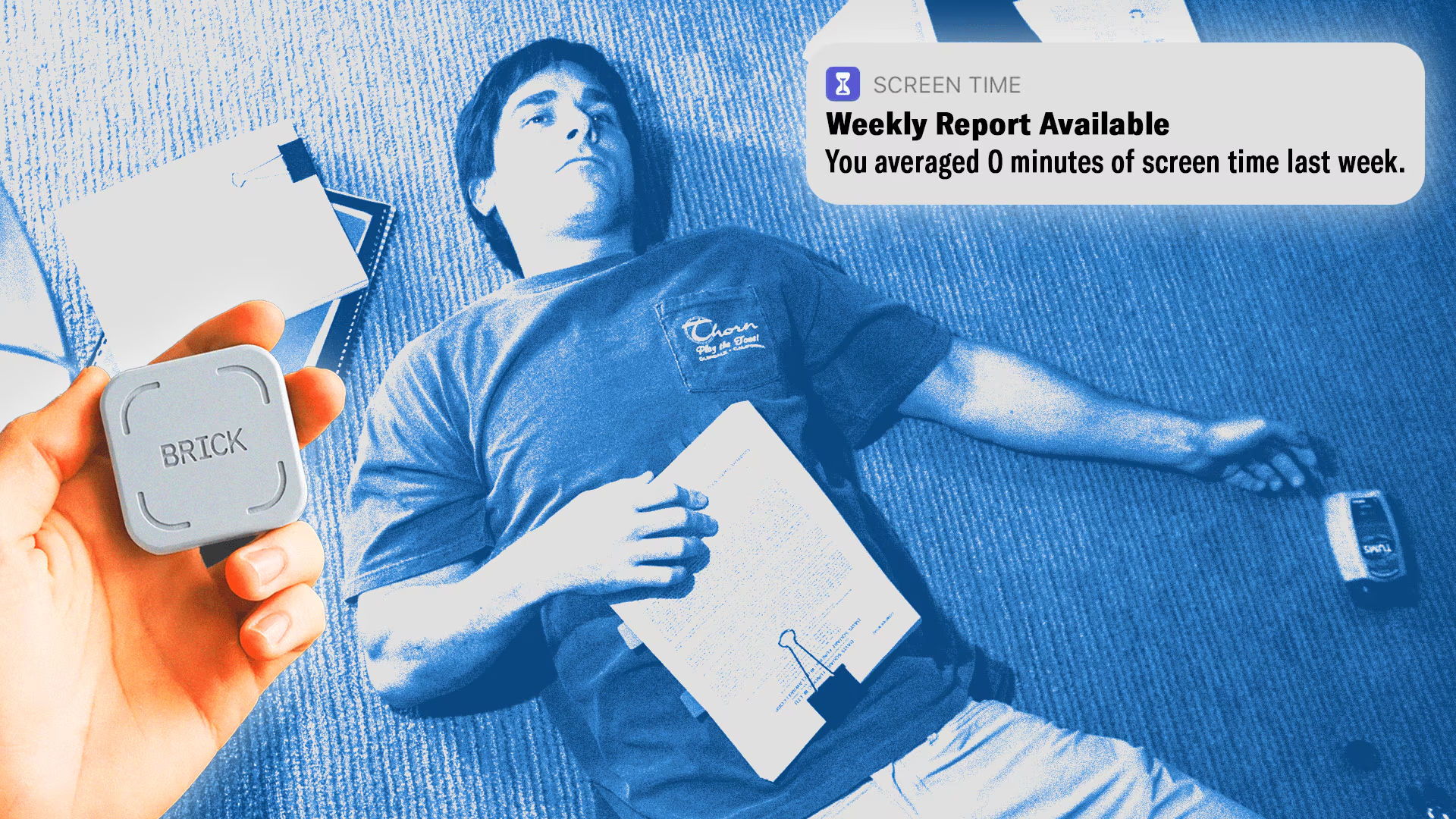
Today, it appears, everyone wants less screen time. Not that it hasn’t always been this way. We’ve long complained about the addiction of the algorithm, the toll of the highlight reel, and the perilous time suck of the apps. Yet now, the desire to be offline seems to have reached a tipping point.
Greg (29) wants more productivity. Pete (41) wants a clearer headspace. Luke (27) wants to limit the constant comparisons. Ben (29) wants to curb the habit he described to me as “psychologically damaging myself on purpose.” You’d be hard pressed not to find a man who is not, at the very least, thinking about reducing their time online.
Sam (30) could, on a “bad day”, spend four to five hours on his phone, sheepishly comparing screen time averages with his friends. “Similar to eating fast food, I’d feel great in the moment, but I’d emerge feeling sick and shameful. And maybe even a bit dumber,” he reflects.
Notably, the desire for offline peace seems to have evolved beyond a personal pursuit to a kind of collective aspiration. A social recalibration that sees those addicted to the apps as ‘sad’ and those opting out as ‘cool’. Whilst seemingly unconscious, the reframe is pervasive. Being offline today has become a flex.
“I definitely think it’s aspirational for men to be offline,” Ben tells GQ. “The hottest thing a man can be it seems is quiet, busy and unaware of himself. Being offline helps you tick all of those boxes.”
Psychologically, the appeal of elusiveness makes sense. As performance psychologist Dr Jo Lukins explains, “a smaller online presence makes someone less accessible. They’re perceived as having greater scarcity, more autonomy, and not needing to engage as openly as the majority of the population.”
Whilst the ambition to reduce screen time is clear, moving from desire to action still proves challenging. Perhaps it’s this difficulty that makes an offline man so compelling. “There is consistent research that [shows] people typically come off social media feeling worse than when they went on it,” notes Lukins. “It feels good [to be online] because it hits our dopamine receptors and offers ongoing micro-rewards.”
Willpower alone often isn’t enough. Luke, who could lose six to seven hours a day to social media— “I have a lot of downtime with my work” —first tried deleting the apps. But this was to no avail. “I would always still be able to go through a browser on my phone.”
Ben similarly had no such luck. “The straw that broke the camel’s back was realising I was getting excited about needing to pee while on a night out so I could excuse myself to have a look at my phone at the urinals. That’s when I realised I had a serious problem.”
For both men, true solace was found in a device called The Brick, a physical tool that removes distracting apps and notifications from your phone. It’s the requirement of physical contact to activate it that seemingly makes it so effective. Naturally, Google trend data shows The Brick has more than doubled in interest in Australia this year.
Its ubiquitous rise points to a growing trend of gamifying our way offline. From “raw dogging” morning commutes, to using apps like Focus Friend, to tracking time ‘bricked’, many are turning the pursuit of offline peace into a game. An endeavour that seems to generate far stronger results than the rigidity of discipline or willpower.
“Self-discipline is often far too rigid,” Dr Jason Fox, philosopher, keynote speaker and author of The Game Changer tells me. “To approach any self-development or improvement with the lens of play is both adaptive and forgiving.”
There’s a reason this works. “A gameful approach allows for a more generative approach to behaviour change,” Dr Fox continues. “You implicitly have agency—no one is forcing you to do this. [It] offers a clear sense of progress. This has been found to be one of the most powerful motivators when it comes to sustaining discretionary effort.”
Of course, digital reprieve can be found through a variety of avenues. Wellness clubs, like Saint Haven, are increasingly present in cities, reflecting a growing appetite for physical spaces dedicated to retreat, disconnection and presence.
As Sean Carey, chief operating officer of Saint Haven shares, “closing the heavy gold door and smelling the white sage incense” marks a clear transition from the busyness of the outside world to the calm within. “Whilst we have a dedicated business lounge and co-working space, our members mainly see Saint Haven as a sanctuary whereby they can escape the chaos of the outside world.”
Beyond this, wellness retreats have long offered the deepest form of disconnection. While every retreat is unique, it’s common for phone use to be restricted, if not entirely prohibited, allowing the experience to take hold. Such an immersion offers a deep nervous system reset, stripping away the sensory overload of technology and allowing space to reconnect with the body, mind and surrounding environment.
“The real truth is that nature is still the most powerful means to bio-harmonising or biohacking,” explains Sonja Sorich, General Manager of SOMA Byron Bay. Nature, she says, has “a direct and correlative effect on both down regulating and upregulating the nervous system in a healthy way.”
That said, immersions—whether retreats or urban wellness clubs—come at a premium. A two to three day stay at SOMA sits at around $3,000, while memberships at Saint Haven range from $200 to $1,000 per week. Gamified approaches to digital reprieve, by comparison, offer a lower barrier to entry.
Despite the growing aspiration to live life offline, for some, opting out isn’t realistic. James Cousins is a musician based in the Northern Rivers for whom Instagram and YouTube are integral to both visibility and income. Reckoning with what he describes as a phone addiction of sorts, fatherhood became the catalyst for questioning his relationship with the feed.
“My son, he’s about 18 months old, was trying to show me something, and I was just looking at stuff on my phone. It made me go, I have to stop this. [But] I guess the thing to confront was always, well, I need to use it, but how do I use it so that doesn’t consume me? And is that even possible?”
He’s around 70 days into a digital overhaul. While he still posts what he needs to for work and remains available on message, he’s shielded himself from the dopamine hits of follower growth, likes and the dreaded doom scroll. The urge to check notifications has been replaced with journaling in his notes app. It’s not a perfect system, he admits, but “it’s way better than it was, without being bombarded with the world’s problems while trying to confront your own.”
Similarly, opting out altogether isn’t equally accessible for those who are single. As Pete tells me, “I really do need to have notifications for Hinge.”
“I didn’t open it while I was overseas, and when I got home, I had 352 unread messages.”


