


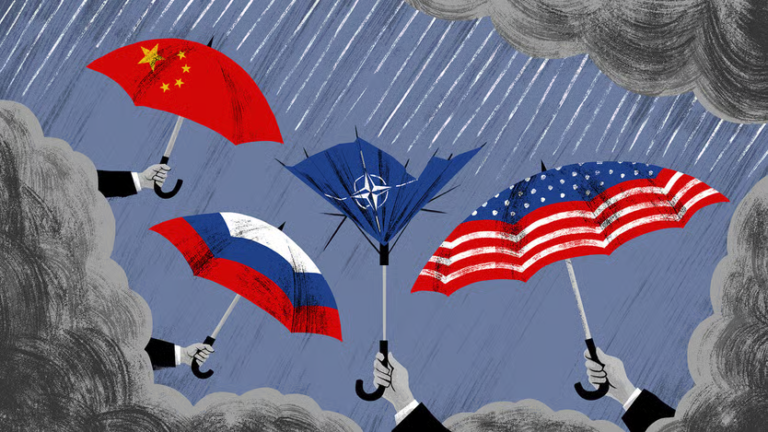
WHEN Russia flew nearly two dozen drones into Polish airspace on the night of September 9th-10th, the NATO alliance proved very good at shooting bad things down. Forces from Germany, Italy, the Netherlands and Poland jointly deployed fighter jets, helicopters, missile batteries and an advanced surveillance plane. Several lumbering, unmanned intruders were destroyed, with no casualties on the ground. It was one of the largest incursions into NATO territory in the history of the alliance, and Europeans can be relieved that their defences worked. They should worry more, though, that Russia dared to test them in the first place.
Western countries are struggling to deter their adversaries, and the provocations are piling up. Unmoved by the vocal outrage of many European leaders, President Donald Trump speculated that Russia’s drones might have wandered into Poland by mistake. A few days later a Russian drone entered Romania’s airspace, and was shadowed by Romanian fighter jets until crossing into Ukraine. Half a world away, China has in recent weeks tightened its grip over a bitterly disputed reef in the South China Sea. Officials in Beijing this month announced a national marine reserve at the Scarborough Shoal, an uninhabited islet of such strategic importance that in 2016 President Barack Obama told his counterpart, Xi Jinping, that a Chinese land-grab there would risk an American military response. On September 16th Chinese patrol ships swarmed around the shoal, blasting water cannon and injuring a coastguard sailor from the Philippines, America’s treaty ally.
To grasp the challenges facing the West, consider how cold war commanders would have greeted a similar incursion by the Soviet Union, suggests Chris Kremidas-Courtney, an expert at the European Policy Centre, a think-tank, who long ago served in a US Army unit watching the skies of Germany for Soviet intruders. If 19 Soviet aircraft had entered NATO airspace, they would have met “a huge response”, with intruders being shot down and massive shows of force on the Western side. Today, Russia’s bet is that the West has “a sharp sword but a shaky hand”, says the expert. NATO’s recent defence of Poland was successful but unsustainably expensive, with million-dollar missiles used to destroy drones costing $20,000. To deter Vladimir Putin, Europe may have to take risks, for instance seizing oil-smuggling Russian ships, or making bolder commitments to help Ukraine. Put another way, political courage will be as necessary as fancy missiles (though cheaper anti-drone weapons would help, too).
Alas, NATO’s political unity has been undermined by Mr Trump’s bullying of allies, and by his open questioning of America’s commitment to collective defence. Meanwhile, the West’s ability to agree on a strong response is hobbled by Russia’s talent for staging ambiguous, deniable attacks. Those may involve drones, cyber-attacks or “grey-zone” operations ranging from acts of sabotage to assassinations and the apparently malicious severing of submarine internet cables. In the cold war, “we had a chessboard we played on, and we knew where the pieces were. Now there is no board, and no rules,” says Kremidas-Courtney.
America and its allies spent decades perfecting their ability to deter the Soviets. Political and military leaders were guided by the principle that it is easier to prevent an act of aggression ahead of time, than to reverse its effects later. “Deterrence by punishment” involved credible threats to impose unbearable costs on a challenger. In the cold war, that included mutually assured nuclear destruction. “Deterrence by denial” aimed to thwart aggressors with physical force. American firepower made an attack on the continental United States unimaginable. Meanwhile allies were covered by “extended deterrence”. That might involve hosting American nuclear weapons, or being under America’s nuclear umbrella. Some leaders were hard to convince. Explaining France’s need for its own nuclear deterrent, President Charles de Gaulle asked whether America would trade “New York for Paris”: ie, unleash a nuclear war to avenge Soviet strikes on France. Other leaders hoped that American forces on their soil would act as human tripwires. Should an enemy attack spill Americans’ blood, they hoped, the superpower would soon ride to the rescue.
In the cold war America and the Soviet Union made remarkable efforts to control risks, says Oriana Skylar Mastro of Stanford University. She has found details in archives of secret contacts between the two powers, intended to avoid American air raids killing Soviet advisers in Vietnam. Today, bipolar competition has been replaced by something far messier and harder to manage, says Ms Skylar Mastro, a China specialist. Evidence abounds of China seeking to undermine American national security in space, or with cyber-attacks. But such aggression is often hard to deter because it is “deniable and reversible”, she says.
America First risks being America alone
Meanwhile, allies doubt America’s reliability. That predates Mr Trump. It is salutary to revisit “The Unquiet Frontier: Rising Rivals, Vulnerable Allies, and the Crisis of American Power” by Jakub Grygiel and A. Wess Mitchell. Published in 2017, it records how Mr Obama took a sceptical view of global commitments. The Democratic president declined to intervene when Russia invaded Ukraine and seized Crimea in 2014, casting that as a regional fight that did not engage America’s vital interests. Back in the Obama years, longtime partners as far afield as Poland, Gulf states and Japan began rearming, as their confidence in America waned.
In Mr Obama’s defence, though he was an unsentimental realist in office, he saw alliances as a source of American strength. Mr Trump’s America First philosophy is a more nihilistic creed. The American homeland is still dauntingly strong. But adversaries see a chance to divide the West. They will not be easily deterred.
