

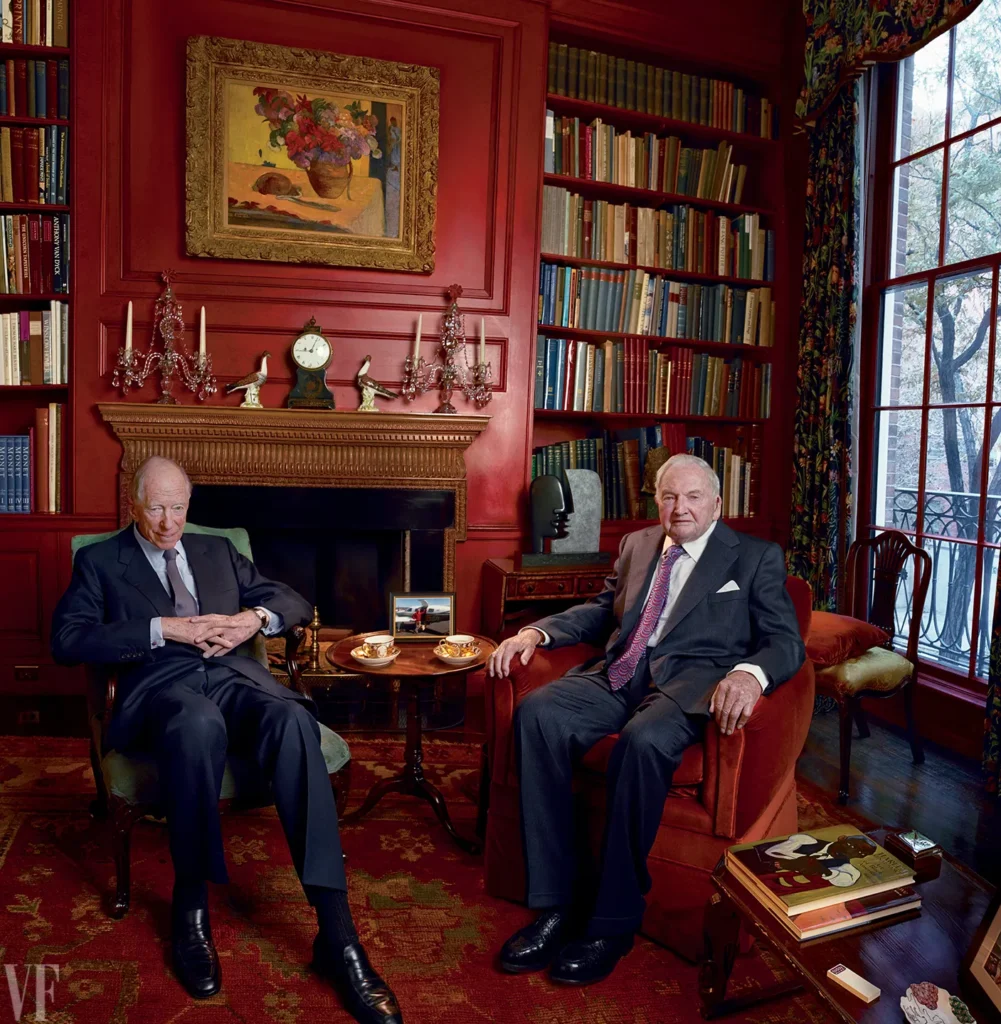
Few families have stood the test of time like the Rockefellers and the Rothschilds. The Rockefellers—founders of the Standard Oil Company in 1870 and a wealth-management firm in 1882; philanthropists of vast generosity in both the arts and the sciences—are considered old money in America. But they are somewhat new-minted compared with the Rothschilds, a name in banking that commenced in the late 1790s and a family whose footprint is large and far-reaching in art institutions all over the world. Three years ago, in May of 2012, the two dynasties came together in a deal that was quietly and poetically momentous.
The deal was done by two remarkable men: David Rockefeller, who is now 99, and Jacob Rothschild—Lord Rothschild, fourth Baron Rothschild—who is 78. Two lions in winter, they have known each other for 50 years; they have also had parallel lives, growing up on grand estates and surrounded by an abundance of art, ancestors, and siblings. David went to Harvard and the London School of Economics and earned a Ph.D. from the University of Chicago. Jacob graduated from Eton and Oxford. They both jumped into careers in finance.
The deal is simple. RIT Capital Partners, led by Rothschild, bought a 37 percent share in Rockefeller Financial Services. In a world of billion-dollar mergers, this is small. In history, it is huge. As Michael Bloomberg, who has more money than Rockefeller and Rothschild combined, has said, “If only my father knew that I know David Rockefeller and Jacob Rothschild, he would be so proud.”
I suspect it is in philanthropy and art preservation that these two new partners will be acclaimed: David, of course, for the Rockefeller Brothers Fund and the Museum of Modern Art (where his mother, Abby Aldrich Rockefeller, played such a prominent role); Jacob, meanwhile, as chairman of the board of trustees of the National Gallery, the National Heritage Memorial Fund, and the Heritage Lottery Fund. The legacy of their deeds raises a question: Who, after they are gone, will make the same commitment to the preservation of the past and the science of the future?