


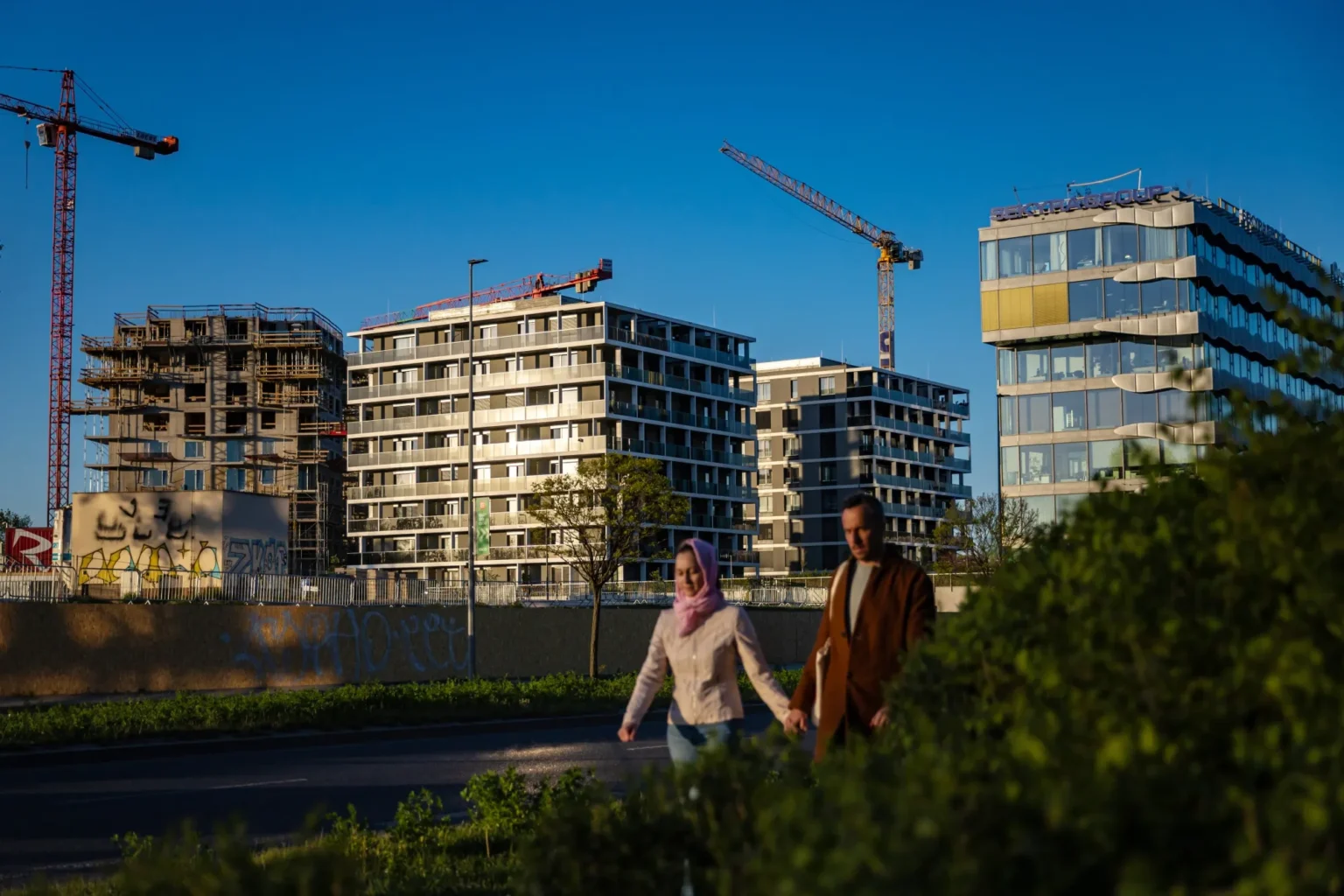
Prague’s historic center of baroque churches, gothic spires, and red-tiled roofs is ringed by modernist concrete apartment blocks. Between the two, new neighborhoods are taking shape, featuring long boulevards, parks and contemporary mixed-use buildings — largely driven by Czech and Slovak billionaire investors.
The two-decade, more than $10 billion transformation of disused rail yards, factories and freight depots, notably in Bubny-Zatory in the north and Smichov in the southwest, is the most significant push to reshape the Czech capital since communism ended nearly 40 years ago.

For developers, it’s as much about leaving a mark on the city of 1.4 million people as it is about financial returns. The Czech economy is growing faster than the European average, and its housing market is one of the region’s hottest.
“Prague is an attractive destination for investors,” said Pavel Hnilicka, founder of Pavel Hnilicka Architects and Planners. “We’re slowly starting to see somewhat larger and more significant developments emerge, of the kind we can see elsewhere in Europe.”
The city’s lateness to this kind of redevelopment, which began in other parts of Europe in the 1960s, can be explained by a range of factors.
Prague escaped much of the bombing and destruction of World War II, even as it spent more than six years under Nazi occupation, from March 1939 until May 1945. Authorities and residents alike are fiercely protective of its historic core, some parts of which date back to the 9th century. Last year, more than 8 million people visited the city — the backdrop to Dan Brown’s recent novel The Secret of Secrets — and Prague alone produced 34.9% of all tourism-sector value added in the country.
But mostly, it’s because of the legacy of communism and the messy transition to democracy. Complex laws, unclear land ownership and red tape meant it took years for land to be returned to its original owners. To avoid headaches, the foreign investors who helped rebuild the wider economy in the 1990s largely shied away from the property sector.
The first overhaul of Prague’s planning framework in decades took effect in September, after lengthy public debates, multiple revisions and tough political negotiations.

Under the Metropolitan Plan, the city now has a more permissive environment for redevelopment, one intended to steer construction toward brownfields and areas well-served by public transport while providing clearer rules for how such sites can be adapted to new uses. The aim is to add much-needed housing without contributing to urban sprawl, demolishing existing neighborhoods, or most controversially, building upwards. Towers of more than 21 floors are allowed, but only in some areas in the south.
At least for the foreseeable future, Prague will continue to look very different to its neighbors, which were far more heavily damaged in World War II and have had less restrictive zoning rules. In Warsaw, for example, the skyline is a mix of office and residential towers. And, in Bratislava, high-rises dominate the new downtown.
“It’s not adding many new layers,” said Martin Ourednicek, head of the Department of Social Geography and Regional Development at Prague’s Charles University said of the developments. “It’s using and transforming parts of the city left behind by the industrial era.”
‘Extraordinary’ Opportunities
In August, roughly a week after turning 34, Europe’s wealthiest man east of Germany, Michal Strnad, emerged as one of the investors behind what will be Prague’s biggest redevelopment projects.
He said AKIPIA, a recently established investment group of which he is a backer, planned to help fund a $4.2 billion project to turn a disused rail yard in the city’s Bubny district into a neighborhood for more than 20,000 people, featuring a park and a new home for the Czech Philharmonic.

In doing so, Strnad joined fellow billionaires Patrik Tkac and Ivan Jakabovic, the Slovak founders of J&T Investment Group, and Marek Dospiva of Penta Investments, whose real estate arm took the lead of the project earlier this year.
The site represents “an extraordinary opportunity,” Dospiva said in written comments.
For decades, Bubny’s railway yard lay mostly empty, with some workshops and warehouses in use until the early 2010s. Plans to redevelop the site date back to at least the 1980s but stalled amid fragmented ownership and disagreement over its future. As part of a separate public project, the nearby train station — from where nearly 50,000 Jews and other people persecuted under Nazi laws were sent to ghettos and concentration camps — is being converted into a Holocaust memorial.
Penta Real Estate, whose CEO David Musil said it uses an internal-rate-of-return benchmark of around 15% when assessing big projects, is already behind some of Prague’s most prominent developments, including Masarycka, a Zaha Hadid Architects-designed office complex in the heart of the city. And, it is preparing Florenc21, a roughly 20 billion koruna ($920 million) drive to turn a neglected space around one of the main downtown transport hubs into a green, walkable neighborhood.

“If in 30 years, people say that Bubny is a great part of Prague, and a good place to live, that will be the best signature for me,” Dospiva said.
Strnad echoed the sentiment in an emailed statement, saying that he wants to see people living “happily’’ in a “modern, thriving” district for generations to come.
In Smichov, a former freight yard is becoming a mixed-use neighborhood, set to be completed by the mid-2030s, that will feature a landscaped boulevard, offices, apartments, shops and cafes.
When Sekyra Group, owned by billionaire Ludek Sekyra, set its sights on the plot at the start of the millennium, CEO Leos Anderle said he had little idea it would take the better part of a generation for construction to begin.
“The Czech market is very specific in that it has been heavily affected, I would almost say paralyzed, by legislation and an extremely complicated permitting process,” Anderle said.
After Prague’s brownfileds are built up, Musil, the Penta Real Estate CEO, believes the city will have no choice but to build higher.
For now, Sekyra Group CEO, Anderle, said he’s happy with the new zoning rules. “I hope I can say this without it being the kiss of death that the Metropolitan Plan really does allow Prague to breathe,” he said. Currently, the capital is adding 5,000 new housing units a year — half of what its Institute of Planning and Development says is needed.

Sekyra Group is also developing or co-developing projects worth over 100 billion koruna combined, including around Rohan, along the Vltava River in north-central Prague, and in Zizkov, a grittier and more bohemian area in the east.
Alongside the looser planning restrictions, there’s been a shift among residents, who appear “increasingly willing to accept new construction,” according to Hnilicka, the architect and urban planner, who is part of the Smichov regeneration.
“Demand for housing is so strong,” he said. “It’s such a powerful current that it will find its way through somehow.”
‘A Vision’
So far, public criticism of the projects has been relatively muted. But all this development comes with a risk. As more people move into areas already woven into the city, pressure will increase on transportation, public services and established neighborhoods, according to Charles’s Ourednicek, who questioned whether the billionaires have too much of a free rein.
“We have experience with building the capitalist city during the Industrial Revolution, when it was more or less very similar — there was free competition and not much central direction,” Ourednicek said. Today, “the private position of the planner tends to be more accommodating to the people in development — in other words, those who are paying.”

Another potential pressure point is housing. Around 77% of residents consider the lack of affordable homes — to rent or buy — a major problem for the city, according to a Kantar survey cited in October by national broadcaster Czech TV. Still, the Metropolitan Plan doesn’t require developers to set aside a certain percentage of affordable units in new complexes; instead it focuses on unlocking land to boost overall supply.
Deputy Mayor Petr Hlavacek, a university lecturer who is himself an architect and responsible for the city’s spatial and strategic development, said he’s seeking better coordination between public authorities and investors. Planning agreements can be drafted to link major projects to contributions for schools, parks, streets and other public infrastructure, giving Prague a way to capture some of the value created when development is granted, he explained.
The market would also benefit from more small and mid-sized developers, according to Hlavacek, who is a front-runner to become the next mayor. He said that during the first Czechoslovak Republic of 1918 to 1938 — which ended with the ceding of border territories to Nazi Germany, Poland and Hungary — the country “was the garden of Europe, with huge numbers of farmers and all sorts of small businesses. Now, we’ve turned into a hub for mega-companies.”
Referring to the Metropolitan Plan, Hlavacek added, “Mistakes and shortcomings will certainly occur, but for the first time in a long while the city actually has a vision.”
