



Small quiz question: What do the USA, Afghanistan, Syria, Venezuela, Taiwan, but possibly also Germany have in common? They are facing or have already completed a political system change. Even if it is just a change from a representative to an authoritarian democracy. Large parts of the population in the countries concerned would like to see the change. For probably just as many people it is sheer horror.
But what happens when something like this happens? How does it capture the individual? We still have the most spectacular, fortunately best-researched example of the French Revolution. It is not written in capital letters for nothing. Because this is the revolution par excellence. Not only did it make the transition from monarchy to popular rule, from Ancien Regime to modernity. With its radicalization and dehumanization that lasted several years, it was also the prime example of a civilizational break, which is usually accompanied by system changes. – As is well known, the implosion of the Soviet Union and its satellites is the exception in history.
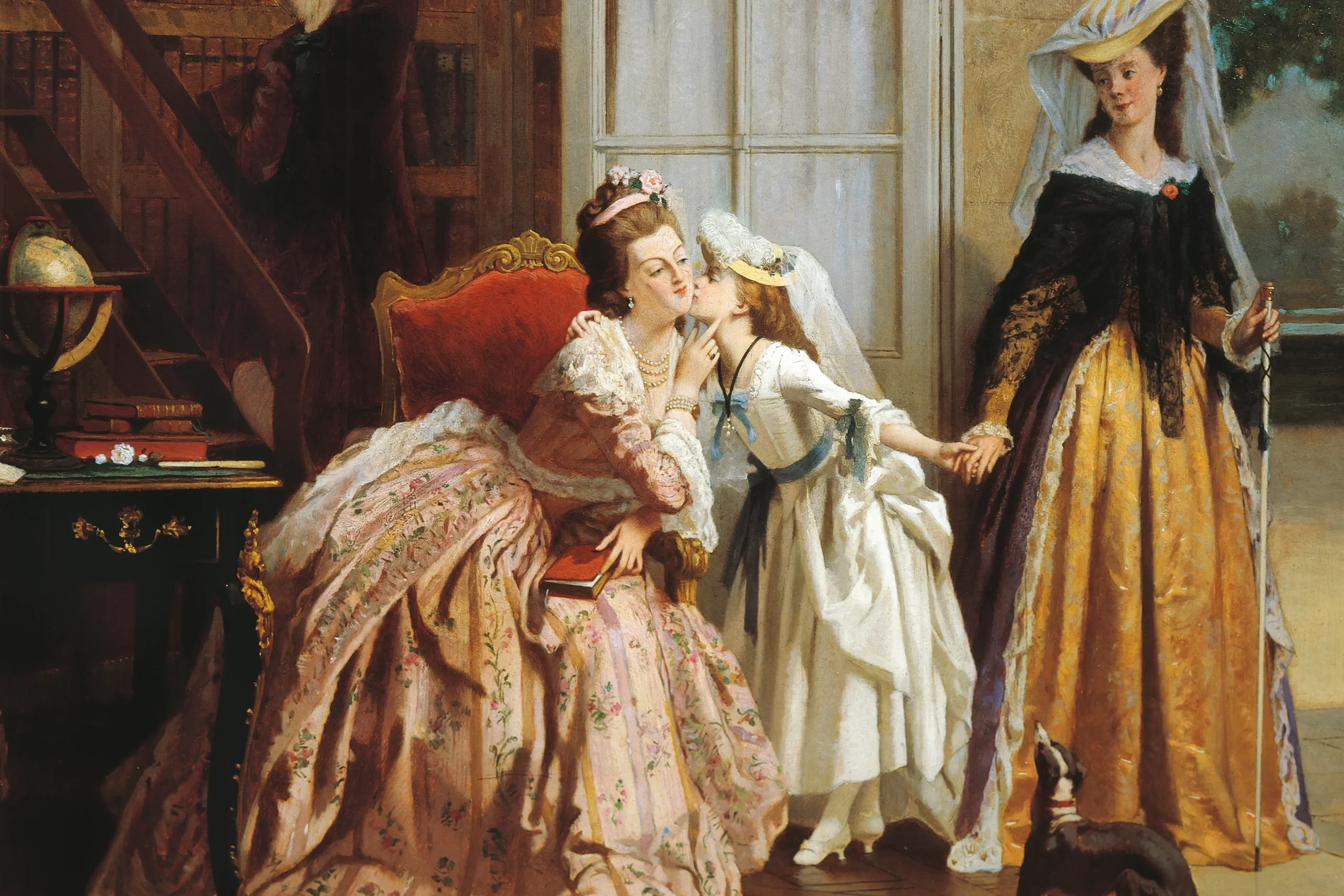
For the system that was swept away from 1789 onwards, the ruling couple is still the undisputed first: King Louis XVI. and Queen Marie Antoinette. After a cascade of humiliation and harassment, both ended up on the scaffold like common criminals. The height of her fall was so enormous, especially with regard to the queen, because she had previously been considered the epitome of the (in the literal sense) careless, cheerful Rococo. This is how it entered our collective memory. Last pointed in Sofia Coppolas Cult film „Marie Antoinette“, which showed Empress Maria Theresa’s daughter as an idiosyncratic style icon in 2006.
Marie Antoinette’s collective imagination was ignited early on: she was already a hate figure in France during the time of the Ancien Regime as an Austrian, foreigner, sex symbol –, even though she had to wait seven years until the king was ready to have his phimosis operated on to be able to consummate the marriage with his wife. And the queen was only granted an extramarital relationship, if at all, when she was disempowered: with the attractive Swedish Count Fersen.
Stoic martyr
In the 19th century, people were particularly fascinated by Marie Antoinette’s sacrifice of a woman who, under the inhumane conditions of the last years of her life, reformed herself into an almost stoic martyr. Stefan Zweig wrote this narrative in 1932 in his widely read novel-like biography, which had the telling subtitle „Portrait of a Middle Character“. The large memorial exhibition in the Grand Palais in Paris, which the opera director Robert Carsen curated in 2008 and which ran for almost a whole year, was still under the spell of this view.
But how do these suggestive narratives relate to reality? And can this reality even be dealt with? The answer is yes. Because we have a unique close-up view of Marie Antoinette. She comes from a woman who was unusually educated for her time: Henriette Campan.
Madame Campan barely survived the revolution, founded a girls’ boarding school under Napoleon, and later headed a training institute for the daughters of fallen soldiers. When the Bourbons returned to rule in 1814, she fell from grace. She spent her last years writing her memoirs. They appeared in the year of her death in 1822 and were entitled „Mémoires sur la vie privée de Marie-Antoinette, reine de France et de Navarre (Memories of the private life of Marie Antoinette, Queen of France and Navarre“). No one, then living as a contemporary witness to the lost Ancien Regime, has questioned the documentary value of these records. They were not yet available in German.
Hans Pleschinski, novelist and probably the greatest connoisseur and lover of the 18th century that we have in Germany, now raised the treasure. He translated it, shortened it carefully, published it together with brief explanations in the text and an instructive afterword and allows this epochal text by Marie Antoinette, who was the first chambermaid of Marie Antoinette from 1770 to 1792, to be considered what it is: an extremely clear and thought-provoking testimony to what we call regime change today.
The Campan lived „in the bubble of Versailles“ for a quarter of a century, as Pleschinski says, and this bubble with its rituals, its splendor, intrigues, but above all its alignment with the ruling couple and their favor comes to life here in great detail. The Campan does not forget to emphasize that the exposed place of the king and his wife was a golden cage, especially for the latter: „The kings have no private life, the queens have no rooms for themselves. Rulers are constantly surrounded by people who pass on their personal customs to posterity; the least servant chats what he has seen or heard, the gossip spreads in no time and becomes public opinion that suddenly appears, grows and shows the crowned heads in a light that is often false but remains indelible.“
What the gossip does not seem to have grasped, however, and what the memoirist now adds, is the zeal for reform that had also gripped Versailles since the beginning of the 1780s, including king and queen. What wasn’t devised to save. Who wasn’t hired, replaced, called again to break the self-blocking of a system that was on the verge of collapse. Marie Antoinette participated in the brainstorming. For example, she campaigned for the court of Versailles to be easily dissolved and moved to the smaller Saint Cloud Castle, with reduced servants. But that would have required a renovation of Saint Cloud, which means it would have cost money. And so the idea was rejected, like so many others: the system proved incapable of self-reform. How familiar this seems to us today!
Imprisoned with little human dignity
What we don’t know (yet) are the hordes of barbarians who, as a result of the regime change, made the lives of those in power and their loyal followers increasingly unsafe, especially after the royal family’s failed escape in 1791. Now the previously highest rulers were held like prisoners; The night before she arrived back in Versailles, 36-year-old Marie Antoinette’s hair turned silly white. Now the mob increasingly gained access to the inadequately secured Palace of Versailles, especially to the Tuileries in the middle of Paris, until finally imprisonment left almost nothing of the royal family’s human dignity.
Since 1792 at the latest, constantly confronted with insults, threats and slander, sometimes in direct physical confrontation, and internally burdened by the constant fear for her own life and that of her loved ones, Marie Antoinette apparently managed to develop an almost incredible resilience. Mirabeau said of her: „The king only has one man, and that is his wife.“ And after the mob stormed Versailles, in which a thousand castle servants lost their lives while the royal couple escaped again, Marie Antoinette reassured her first chambermaid with the words: „I have strength. The misfortune gives great strength.“
Let’s wish her that it was like that! Perhaps the insight that their terrible end was also politically logical had contributed to their stoicism. Because revolutions and regime changes usually take place without regard to the person. They behave as a force of nature, pre-human, inhumane. In any case, this stirring book conveys this message. Let’s learn from it!
